News

Blood Drive – October 8, 2025

Wednesday, Oct. 8, 2025 from 9:00am to 3:00pm in the Large Social Hall.

Drive Details:

St. Mary Cause of Our Joy Catholic Church
8200 N. Wayne Rd,
Westland, MI, 48185

Register for a time at:
https://www.redcrossblood.org/give.html/drive-results?zipSponsor=stmarywestland

Thank you for supporting the American Red Cross blood program!

Download the Red Cross Blood Donor App on the App Store, Google Play or text BLOODAPP to 90999. Schedule appointments, get rewards and invite friends to join you on a lifesaving team.

Adult Catholic Book Studies

Beginning in January we will have two opportunities for Adult Catholic Book Studies. The 1st will be on Wednesday mornings from 10:30 to 11:30, January 8 thru January 29. This study session is on “The Three Ordinary Voices of God”, by Matthew Kelly. Sabrina Queen and Jeanine Frantsen will be the facilitators. If you would like to reserve a spot, please call Sabrina at the Parish Office – 734-425-4421 ext. 217. Book donation is $5.

The second study will be on Thursday mornings 10:00 – 11:30 from January 23 thru February 27. This study session will be on “The Creed”, by Bishop Robert Barron. Paul Zdieblowski will be the facilitator. Paul is the Pastoral Associate and Director of Evangelization at St. Mary, Wayne. Information and registration forms are in the Gathering Area.

Blood Drive – October 12, 2022

October, 12, 2022 from Noon to 6:00pm in the Large Social Hall.

Drive Details:

St. Mary Cause of Our Joy Catholic Church
8200 N. Wayne Rd,
Westland, MI, 48185

Register for a time at:
https://www.redcrossblood.org/give.html/drive-results?zipSponsor=stmarywestland

Thank you for supporting the American Red Cross blood program!

Download the Red Cross Blood Donor App on the App Store, Google Play or text BLOODAPP to 90999. Schedule appointments, get rewards and invite friends to join you on a lifesaving team.

Little Free Pantry

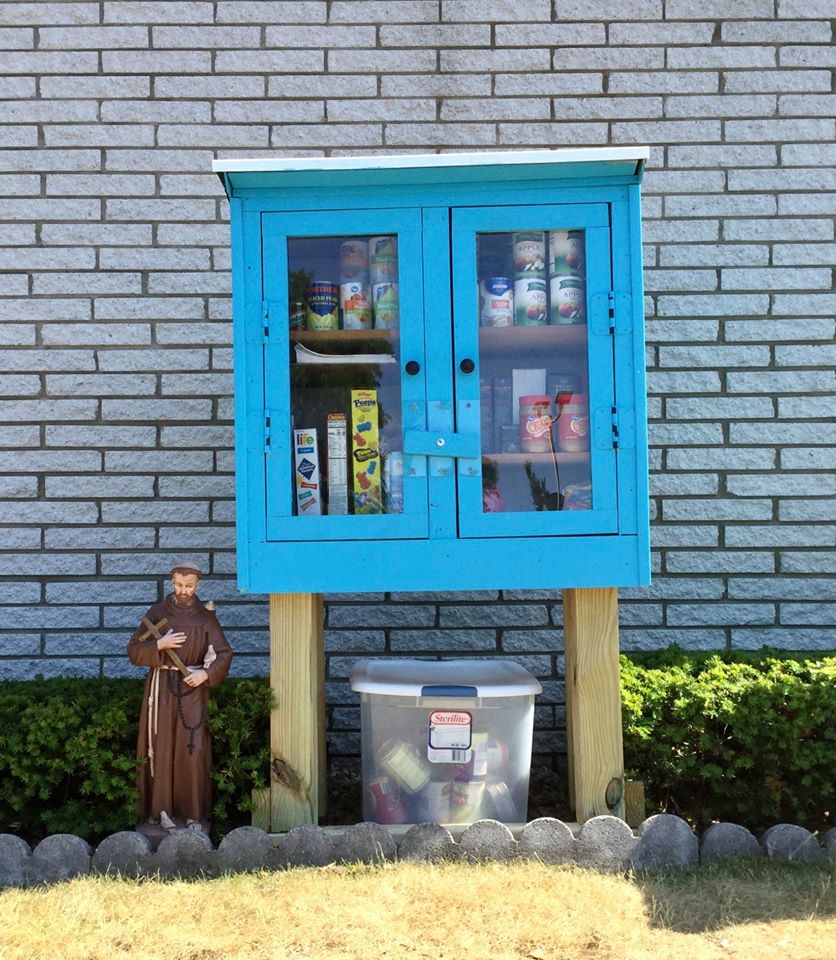
Our Little Free Pantry is finally here!

Thank you Knights of Columbus, Msgr. Kohler #15204 for building it for us!

We hope everyone in our community will use this box, both to bring food, but also to take food when they need a little help. Look for it next to our office building!

"For I was hungry, and you gave Me something to eat; I was thirsty, and you gave Me something to drink..." Matthew 25:35

“Take what you need, leave what you can.”

Cremation And The Order Of Christian Funerals

Excerpts from:  January 2012 Newsletter of the Committee on Divine Worship

 Ideally, if a family chooses cremation, the cremation would take place at some time after the Funeral Mass, so that there can be an opportunity for the Vigil for the Deceased in the presence of the body (during “visitation” or “viewing” at a church or funeral home). This allows for the appropriate reverence for the sacredness of the body at the Funeral Mass: sprinkling with holy water, the placing of the pall, and honoring it with incense. The Rite of Committal then takes place after cremation.

The cremated remains of a body should be treated with the same respect given to the human body from which they come. This includes the use of a worthy vessel to contain the ashes, the manner in which they are carried, and the care and attention to appropriate placement and transport, and the final disposition. The cremated remains should be buried in a grave or entombed in a mausoleum or columbarium. The practice of scattering cremated remains on the sea, from the air, or on the ground, or keeping cremated remains on the home of a relative or friend of the deceased are not the reverent disposition that the Church requires.


The silence of God when we pray

Last weekend, I wrote about silence in our church, and the need to respect the Eucharist and others who are praying and listening to God. This weekend I would like to write about another silence. The silence of God when we pray.Silence_(2016_film).png

I am not much of a moviegoer; however I recently went to see the movie SILENCE, directed by Martin Scorsese. This movie is based on a book written by a well-known Japanese Christian author, Endo Shusaku. It is the story of Jesuit missionaries in Japan in the 1600’s, and the hidden Christians that they encountered. If you get a chance, I heartily recommend this film. It gives a good insight into the torture and persecutions that the Christians endured. For more than 250 years, Christianity and all contact from the outside world was outlawed in Japan. The Christians that remained were forced to practice their faith underground; if they were discovered they were often tortured, even martyred. The film portrays the life of these heroic Christians, and the lives of the missionaries sent to them.

The “silence” that this film refers to is the silence from God when we pray to Him and seem to hear nothing. Those who were being tortured for their faith prayed, and it seems that God wasn’t listening. Time and again in the history of Christianity in Japan, believers were told that if they just renounced their faith, by trampling on a cross (called a fumie) they would be freed, escaping the horrendous torture awaiting them. Why did it seem that God was not there for them? Wouldn’t God help them in their moment of most need? One of the missionaries continues to see the haunting face of Jesus over and over again, the face from a picture hanging in the seminary where he studied. It is a face he loves and serves; but the face never speaks. It remains silent when the priest is chained to a tree to watch the Christians die, silent when he asks for guidance on whether to commit the trampling on a cross (fumie) to set them free, and silent when he prays in his cell at night.

Although the movie ends in seeming ambiguity, the author’s intent was to confirm that God is not silent; He does speak to us, just not always in the ways that we would expect.

In our own lives, as well, there are times when we wonder if God is really there. Is He listening to me? Doesn’t he know the troubles in my life? I try to do everything for God, where is he? Sometimes our image of Jesus is one of majesty and power; the one who can do anything and everything. As we can learn from the movie, Jesus is also the one who suffered for us and is suffering with us. Jesus al- lows our weaknesses. Jesus, too, was weak and powerless. Often times, the answer from God is there, we just don’t hear it or don’t acknowledge it. Great saints, such as St. Theresa of Calcutta (Mother Theresa), asked God why He seemed to remain silent. Sometimes the deepest answers and love come in moments of silence. All we need to do is listen with an open heart.

Fr. Ken

The silence before mass…

Many of us enjoy coming to church for a number of reasons. Not only do we get a chance to be closer to God, but we also get to see some of our friends, people that we have known perhaps for a long time, which gives us a chance to catch up on what is going on in each other’s lives. Some people come to church to be able to serve in one way or another: singing in the choir, assisting at Mass in one or more ways, even cleaning during the quiet times when the church is empty. But most importantly, we come to church not for ourselves, not for our friends or for something to do. We come to church for God.

A friend of mine told me that years ago, one of the things that she brings to church in addition to a prayer book and a rosary was a set of ear plugs. EAR PLUGS? Yes, she told me. She comes to church and wants to spend some quality time with God. And try as she might, inevitably someone walks in and begins talking in a loud voice, or yelling across the church at a friend, and there is distraction from her listening to God.

Unfortunately, I would have to tell her that our church is the same. I am often stunned by the high level of noise coming from people’s voices before Mass. Talking, even yelling at one another, as if they were in the playground. The church is a sacred space, a place where many people come to talk…to God. Not to you. I wish that we treated our sanctuary as a sacred place, a place reserved for silence and mystery and reverence and prayer. I realize that our gathering space is small and the space is limited, and especially during the cold winter months, it is not easy to stand outside while we chit chat. However I often look around, both before Mass and afterwards, and see the individuals, struggling to remain in silence, while others around them carry on conversations, and not in whispering voices.

The church is not just another large room, a hall or movie theater. There is something different here, something worthy of worship. The silence of a church isn’t a fearful silence of a slave before his or her master; it’s the stunned silence of an adopted child basking in his Father’s love. It’s a soul washed clean standing before her Lord, gasping, “See what love!” The silence demanded by God’s sanctuary is one of gratitude, of intimacy mingled with awe.

So I invite you, friends, to take your conversations outside. If someone starts chatting with you, encourage him or her (in a whisper) to join you in the gathering space. Before Mass begins, kneel and pray in silence as a witness to the power of a silent sanctuary. Perhaps the people around you will be struck by your reverence and recognize more fully the God who is present to us in the tabernacle. You may find that your example draws other people to silent prayer, too.

Fr. Ken

A kinder, gentler nation

Twenty-nine years ago, during his acceptance speech at the Republican National Convention, George HW Bush called for a kinder, gentler nation. Although I may or may not have been a supporter of Mr. Bush, those words have always stuck with and I have tried to make them almost a motto for my life, my words and my actions.

Now, nearly three decades later, I think that this is even more necessary for our lives, not only in our nation (I am not here to write anything political) but in our daily lives, and even in our church. We need to be kinder to one another, we must be gentler in our words, actions and attitudes. Perhaps when I was younger, I might have been bolder, fiercer in pushing my beliefs around; to be honest, I don’t remember. Perhaps it is because of my life in Japan, where such aggressive attitudes are unacceptable, I have long ago come to realize that fighting with kindness is much more effective than returning with aggressive responses. I am not talking about political rallies and protests; I am speaking about our life, in our families, neighborhoods and church. There are groups and individuals who rarely have a nice thing to say, or a nice way of putting things. I am not a fan of the “in your face” mentality. Being kinder and gentler is easy on your stress level and blood pressure as well. In the Beatitudes, which we read during the Gospel last weekend, Jesus tells us, “Blessed are the peacemakers” and “Blessed are the meek”. In a few weeks, we will hear the passage where Jesus says: “You have heard that it was said, You shall love your neighbor and hate your enemy. But I say to you, love your enemies and pray for those who persecute you.”

Strong armed tactics. Attitudes or self-righteousness and superiority. Words which cut down others, even those with whom we disagree. None of this should have a place in our lives. I am not speaking of warm, cozy and fuzzy feelings. We need not be running around hugging all the time; nor do we need to be sentimental, with tears welling up in our eyes. I mean, rather, a mature attitude of treating all people with respect. Of watching our words and actions carefully, rather than quoting the First Amendment to support the fact that. “I am free to say whatever I want…or however I want to.”

May we all strive to become kinder and gentler.

Fr. Ken

Beatitudes

There used to be a common practice among Catholics called the “examination of Conscience”. An examination of conscience is a “prayerful self-reflection on our words and deeds in the light of the Gospel to determine how we may have sinned against God and others” Perhaps some of you still do this, particularly before receiving the Sacrament of Penance. Many times, people will look at the Ten Commandments to examine their sinfulness.

While this is a good start, the Ten Commandments are not the only instrument we should use to judge ourselves. Reflecting on the Beatitudes (Blessed are the poor in spirit, blessed are the meek…etc) is an excellent way of continuing to reflect and examine ourselves.

Pope Francis recently reminded us that the Beatitudes are, in some sense, the identity card of the Christian because they identify us as followers of Jesus. He says that we are called to be blessed, to be followers of Jesus, to confront the troubles and anxieties of our age with the spirit and love of Jesus. Thus we ought to be able to recognize and respond to new situations with fresh spiritual energy. The pope also suggested some modern day beatitudes. While they do not replace the ones of Jesus, of course, they should give us something to think about, and to use when we examine our conscience.

  • Blessed are those who remain faithful while enduring evils inflicted upon them by others, and forgive them from their heart.
  • Blessed are those who look into the eyes of the abandoned and marginalized, and show them their closeness.
  • Blessed are those see God in every person, and strive to make others also discover him.
  • Blessed are those who protect and care for our common home.
  • Blessed are those who renounce their own comfort in order to help others.
  • Blessed are those who pray and work for full communion between Christians.

All these are messengers of God’s mercy and tenderness, and surely they will receive from him their merited reward.

Fr. Ken